
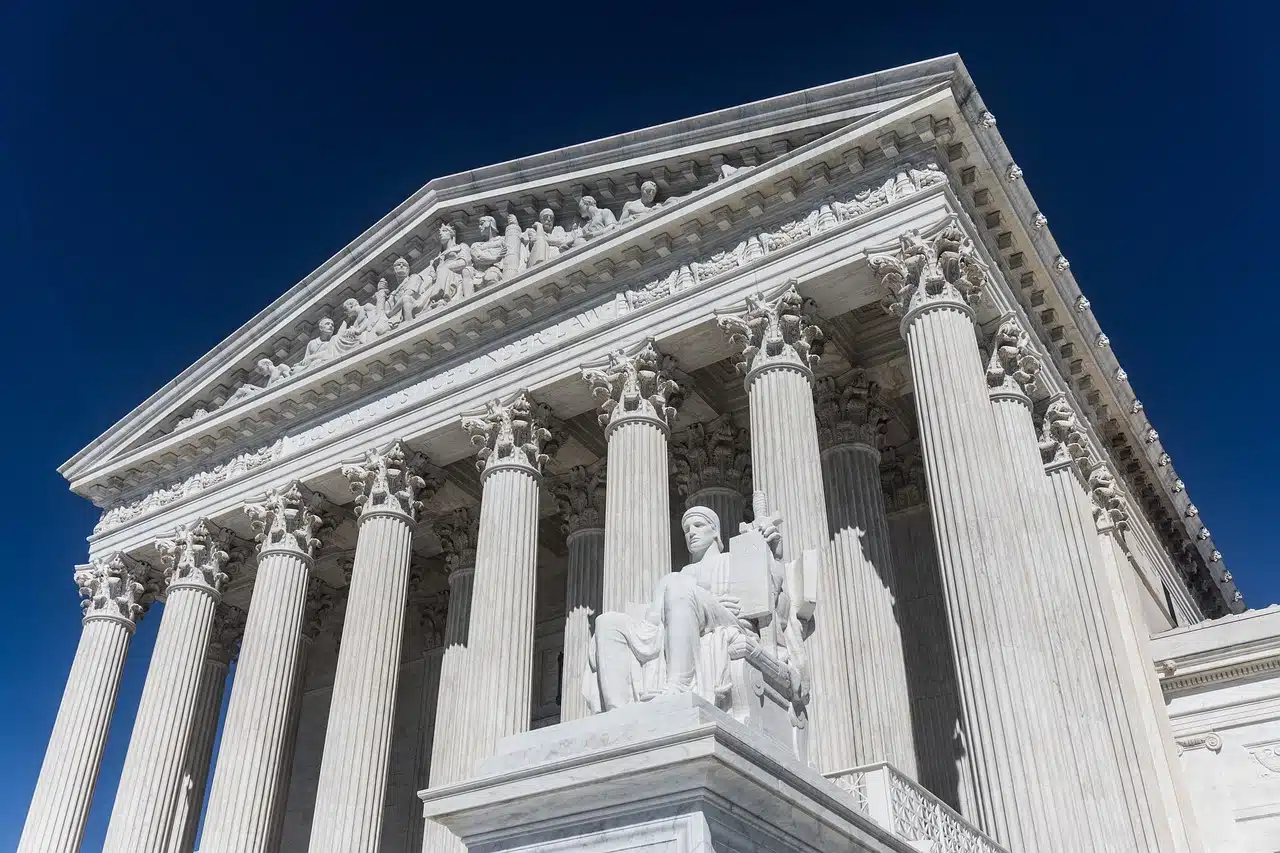
In the nation’s capital, late June and early July nearly always bring sweltering heat, stifling humidity…and decisions in some of the Supreme Court of the United States’ (SCOTUS) most high-profile cases.
The high temps and atmospheric moisture have arrived, and while we know how the SCOTUS justices feel about the Consumer Financial Protection Bureau’s (CFPB) funding structure — seven determined last month that it is indeed constitutional — we are still waiting on some big decisions. For example, SCOTUS has not yet issued a decision in two cases, Loper Bright Enterprises v. Raimondo and Relentless, Inc. v. Department of Commerce, that were combined.
What are these cases, what do they challenge, and what could the decisions in them mean for the financial services and financial technology industry?
Let’s take a look.
Fishermen Take On An Agency’s Rulemaking Authority
As the judicial research website Oyez explains, these two Supreme Court cases came about after the National Marine Fisheries Service (NMFS) issued a final regulation that required the fishing industry to fund an at-sea monitoring program that would cost an estimated $710 per day.
That burden was too much for a group of commercial herring fishermen from the Atlantic coast, and they took their grievances to federal court. Part of what the group argued was that the federal law that governs their industry, the Magnuson-Stevens Fishery Conservation and Management Act of 1976, did not grant the NMFS the authority to create an industry-funded monitoring program.
If acting as a federal agency without the express authority of Congress sounds, well, fishy, under current legal precedent, it is totally above board, at least for now. As Oyez notes, courts look at two questions in cases like Loper and Relentless: does federal law expressly give an agency the authority to create a program or issue a regulation and, if it did not, is it reasonable to give the agency the benefit of the doubt and allow it to move forward with its preferred policy under current statute?
Under that legal precedent — the Chevron deference principle — a federal court’s answer to that second question was, generally, yes. As such, a district court ruled against the fishermen, as did the U.S. Court of Appeals for the D.C. Circuit. But, feeling salty, the fishermen appealed to SCOTUS.
What Is Chevron Deference?
A provision in the Clean Air Act, a federal law enacted in 1970 that regulates sources of air emissions, requires that U.S. states that had not yet achieved national air quality standards must establish a permit program regulating new or modified major stationary sources of air pollution, including manufacturing plants.
Nearly a half-century ago, a case erupted challenging how the U.S. Environmental Protection Agency (EPA) had interpreted its authority under this provision.
As Oyez explains, the EPA issued a regulation that allowed states to treat all pollution-emitting devices in the same industrial grouping as though they existed in a single “bubble.” Using this bubble framework, plants could install or modify one piece of equipment without getting a permit as long as that change did not increase the plant’s total emissions. Several environmental groups, including the Natural Resources Defense Council (NRDC), argued the Clean Air Act did not give the EPA the authority to approve this type of program.
A federal appeals court agreed with the NRDC. The Chevron Corporation did not and took its appeal to the highest court in the land. That is where Chevron deference was born. Forty years ago this year, in 1984, the Supreme Court issued a decision in Chevron v. Natural Resources Defense Council that determined that if Congress has not directly addressed the precise question at issue in a case, rather than imposing the court’s own interpretation of a statute, judges should defer to an agency’s interpretation of a law as long as that interpretation seemed reasonable. In other words: when it comes to rulemaking, federal agencies generally get the benefit of the doubt — the judiciary must defer to them.
The ruling was unanimous.
Of course, this principle made it more difficult to challenge federal agency rules. In fact, according to the law firm Holland & Knight, Chevron deference has been applied in more than 18,000 federal legal decisions. The principle has been challenged before this current SCOTUS case, and, as CNN explained, it “was fortified by subsequent decisions at the DC Circuit U.S. Court of Appeals, which specializes in regulatory disputes, and then reinforced by the high court itself.”
But, of course, the ideological and political leanings of the nine SCOTUS justices in 1984 aren’t necessarily the same as the current court. So is the Supreme Court likely to uphold Chevron deference again?
What Did Oral Arguments Indicate About Where Justices Stand?
The nine justices that currently sit on the Supreme Court heard oral arguments in Loper and Relentless in January of this year.
According to Holland & Knight, three liberal justices, Justices Elena Kagan, Sonia Sotomayor and Ketanji Brown Jackson, appeared inclined to leave Chevron deference in place. At least three other justices who traditionally hail from the more conservative wing of the court — Clarence Thomas, Neil Gorsuch, and Brett Kavanaugh — seemed to want to overturn it. The basis for their skepticism, Holland & Knight explains, is that “these justices generally view the U.S. Constitution as charging courts, not administrative agencies, with the authority to interpret federal statutes according to their own independent judgment.”
The Supreme Court watchers at Holland & Knight could not decipher how Chief Justice John Roberts and Justices Samuel Alito and Amy Coney Barrett were likely to rule. Vox analysts disagreed with that assessment, however, putting Justice Alito with the group that would like to overturn Chevron deference.
Between Justices Roberts and Barrett, Vox said Barrett “appeared the most open to preserving Chevron.” The news outlet noted that Barrett “repeatedly expressed concerns about the disruptive consequences that would result from overruling one of the most widely cited Supreme Court decisions of the last century.” Vox also said, “Barrett appeared troubled by the ‘flood of litigation’ that would result if all of these decisions were called into question.”
There is no doubt that overturning Chevron deference would send shockwaves through federal regulatory agencies and every single industry in the U.S. economy — at least for fairly recent rulemakings. “For a host of reasons, including substantial reliance interests, courts are unlikely to revisit longstanding regulations without an express ruling from the Supreme Court that invalidates the basis on which they were sustained in the first place,” say legal experts at Foley Hoag. Still, “if the Court overturns Chevron, agency rules upheld in the past … may be vulnerable to attack … The Solicitor General predicted … ‘litigants will come out of the woodwork, seeking to open those decisions’ on the ground that the statute must be interpreted without granting any deference to the agency’s interpretation.”
Other analysts agreed. “Overturning Chevron deference could have cascading effects starting with the likelihood that more agency regulations will be overturned by courts,” the Kaiser Family Foundation (KFF) says. KFF also notes that “court decisions to overturn regulations will provide increasing incentive by litigants to challenge any and all regulations in court. The ultimate result is a chilling effect on the issuance of federal regulations needed to implement key federal consumer protections.”
A Tale Of Two Regulations: What Would Overturning Chevron Mean For Financial Services
To illustrate what could happen if Chevron is overturned, let’s examine the potential outcomes for two regulations readers are familiar with: the CFPB’s Section 1033, or open banking, regulation, and the U.S. Securities and Exchange Commission’s (SEC) final climate disclosure rule.
The fate of the CFPB’s open banking rule is fairly easy to surmise. Because federal lawmakers expressly provided the agency with the authority to create an open banking regime in Section 1033 of the Dodd-Frank Wall Street Reform and Consumer Protection Act, this rule probably would not be part of the deluge of regulations that would be challenged if SCOTUS overturns Chevron. (That does not mean opponents could not challenge the rule on some other grounds, however, though the regulation is one of the few on the federal docket today that has bipartisan support.)
The outlook would be much different for the SEC’s climate disclosure rule. The laws the SEC cited in that final rule — the Securities Act and the Securities Exchange Act — were enacted, respectively, in 1933 and 1934. Climate change was, of course, not a phenomenon mentioned in those laws. If Chevron deference is overturned, it will provide a boost to the litigants who already are challenging the agency’s regulation. Indeed, after SCOTUS announced last year that it would reconsider Chevron, Jill Fisch, a securities-law professor at the University of Pennsylvania, told The Wall Street Journal the decision could impact the climate disclosure rule. “If Chevron is on the table, they will raise arguments that either it doesn’t apply, or that it is dead and that the court should play a greater role in examining the scope of the statutory mandate,” Fisch said at the time.
Of course, if Chevron is overturned, it will not just be financial services and technology regulations that are challenged. Every rulemaking by every federal agency will be under scrutiny from U.S. industries, their legal teams, and trade associations.
It’s gearing up to be a hot summer at the Supreme Court.