
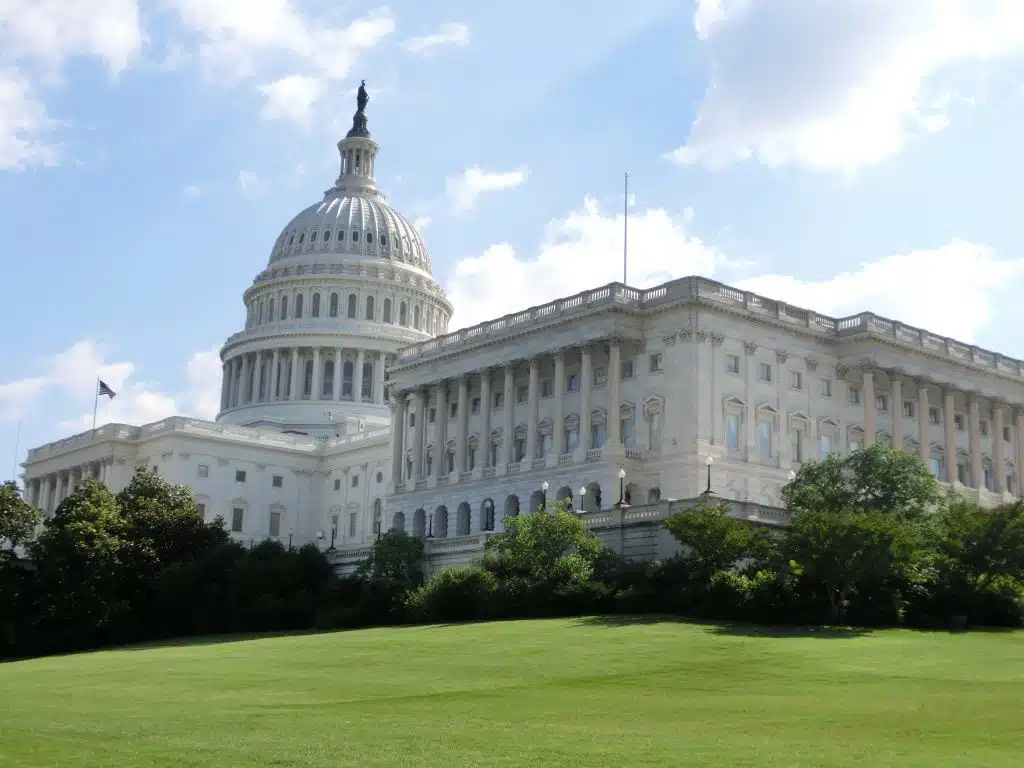
In the papers and on cable news, most eyes are on Washington’s tax and spending fights — President Donald Trump’s release of his “skinny” fiscal year (FY) 2026 budget and Senate consideration of the One Big, Beautiful Bill Act (OBBBA, or the FY 2026 budget reconciliation that calls for cutting taxes and spending and raising the debt ceiling) have both been the subject of intense media coverage.
But there is another battle brewing in the upper chamber of Congress.
Senators are about to consider the Guiding and Establishing National Innovation for U.S. Stablecoins, or GENUIS, Act, which would create a federal regulatory framework for payment stablecoins, or digital assets that are pegged to the value of a fixed asset like the U.S. dollar. The U.S. House of Representatives has approved similar legislation and, in the Senate, the bill has already overcome a filibuster attempt thanks to bipartisan support.
Those skirmishes may look mild, however, compared to what could soon happen this week in the Senate. Indeed, while the GENIUS Act enjoys bipartisan support — a rarity in the halls of Congress these days — its passage is still very much in jeopardy.
Why? Let’s take a look.
A 20-Year Debate Over Debit, Credit Interchange Fees
Fifteen years ago, when lawmakers were debating the Dodd-Frank Wall Street Reform and Consumer Protection Act, Sen. Dick Durbin (D-Ill.) successfully attached an amendment to the bill that limited the fees that financial institutions could assess on debit card transactions.
Sen. Durbin had been trying to find a vehicle for this policy for several years by that point. He said fee caps were necessary to protect consumers and spur competition in the payments sector.
“Wall Street reform is really about two things: holding the big banks accountable for how they operate and empowering consumers to make good financial choices. Passage of this amendment is a win for the public on both fronts,” Sen. Durbin said at the time. “Passage of this measure gives small businesses and their customers a real chance in the fight against the outrageously high ‘swipe fees’ charged by Visa and MasterCard. It will prevent the giant credit card companies from using anti-competitive practices, allow merchants to offer discounts to their customers, and restore common sense and fairness to this broken system.”
Banks and credit card companies strongly opposed the Durbin amendment, while consumer groups and retailers both big and small rejoiced, arguing the new policy would ultimately generate savings for American consumers. Opponents of the Durbin amendment have spent a decade-and-a-half arguing that those predictions have not come true. They say that while retailers have saved money, there is little evidence that those savings have been passed on to consumers. Opponents also note that covered banks and credit unions have recouped their losses from the fee caps by eliminating consumer perks like free checking accounts or by raising minimum balance requirements and charging higher maintenance fees.
Despite his legislative victory and the debate about the actual effects of his amendment, Sen. Durbin repeatedly has made it clear he was not satisfied with capping only fees for debit cards. For years, he has been trying to extend the policy to credit card interchange fees as well.
The fight that has ensued over the last 15 years has been, perhaps, the most expensive lobbying campaign inside the Beltway since Dodd-Frank was enacted into law. Banks and merchants each have spent tens, possibly even hundreds, of millions of dollars to bolster their arguments, which have divided members of the House and Senate not so much on partisan or ideological lines but based on whether they represent more banks than merchants in their states or districts.
Bipartisan Duo Introduce Interchange Amendment
Though it is totally unrelated to the regulation of stablecoins, the debate over interchange fees will be front and center as the GENIUS Act moves forward in the Senate.
That’s because Sen. Roger Marshall (R-Kansas) and Sen. Durbin could offer their Credit Card Competition Act (CCCA) as an amendment to the bill. Their amendment calls for altering the Electronic Fund Transfer Act to require the Federal Reserve to implement regulations within a year of passage that would prohibit card issuers or the networks with assets totaling more than $100 billion from restricting the number of networks available to merchants for processing credit card payments. More simply, the amendment would require competition and cap interchange fees on credit card processing.
The amendment, which could be voted on as early as this week, also would prohibit card issuers and networks from forcing merchants to use security technology for processing credit card transactions if that technology is not offered for use with all of a merchant’s networks.
The Bank Policy Institute is one of the entities leading the charge against the Marshall-Durbin amendment. “The Durbin Marshall Credit Card Mandate, a poison pill amendment that has not been properly considered through the regular legislative process, would harm consumers, small businesses, and financial institutions alike by reducing choice, increasing costs and fraud risks, and creating economic challenges for small financial institutions,” BPI and its allies wrote in a letter to Senate leaders.
Retailers, meanwhile, are getting ready for battle.
“This 20-plus-year battle for credit card reform could be decided by which industry best showcases its grassroots voice on the issue,” said National Association of Convenience Stores Vice President of Government Relations Lyle Beckwith. “Our industry engagement could be the difference in whether we finally get relief from outrageous swipe fees.”
While The Marshall-Durbin Amendment Sink The GENIUS Act?
With consideration of the GENIUS Act imminent, Senate Majority Leader John Thune (R-S.D.) has pledged to return the chamber to “regular order,” which means the debate will allow for an open amendment process. In other words, Sens. Marshall and Durbin will have free rein to offer their amendment.
Because the credit interchange issue is so divisive, stablecoin organizations are now jumping into this debate as well, even though the subject matter isn’t directly relevant to digital assets.
“The credit card measure … is such a fraught policy battle because it pits two powerful lobbying conglomerates — the financial sector and major retailers — against one another,” Politico reported Monday. “Crypto supporters, who are within spitting distance of their biggest win ever in the Senate, are scrambling to prevent the credit card provision from derailing their stablecoin bill.” Politico explains further: “It is highly unclear how a vote on the Durbin-Marshall provision would go: Most senators haven’t taken a position on the matter (and they likely aren’t eager to). But the fear for pro-crypto lawmakers is that it could garner enough support to be adopted as an amendment with backing from most Democrats and some Republicans — and then tank the underlying stablecoin bill by peeling off GOP senators who oppose the credit card amendment.”
Sen. Thom Tillis (R-N.C.) is one lawmaker who supports the GENIUS Act, but who has pledged to change his vote if the Marshall-Durbin amendment is adopted. “It’s a deal-killer,” he told Politico, arguing he would “do everything” he could “to kill” the GENIUS Act if it caps credit interchange fees. Sen. Tillis concluded, “If it goes in it, the value out of the stablecoin components would not outweigh the damage done by CCCA.”
Politico reported other lawmakers are not eager to take a position on a matter since they could potentially “alienate a powerful interest.” Regarding banks and retailers, Sen. Kevin Cramer (R-N.D.) told Politico, “I love them all.” Sen. Cramer also said, “I have some sympathy for that issue, but I also think it would kill the bill if it were passed. A lot of people that would be sympathetic to the cause would vote ‘No’ for the sake of the larger bill. And because of that, I don’t think the vote really helps do anything, including identify ‘Yes’ votes.”
Sen. Cramer said his mind is not yet made up on whether to support the Marshall-Durbin amendment.
As his example shows — and because this issue divides even members of the same party — getting a reliable hard whip count on the Marshall-Durbin amendment will be nearly impossible. And, of course, there is this question: What if the amendment vote ends in a tie?
As a reminder, Vice President J.D. Vance holds the cards (pun intended) in such a scenario — and, at least according to recent history, that bodes well for retailers.
Last year, then-Sen. Vance joined Sens. Marshall and Durbin when they introduced the CCCA as a standalone bill. “Working families all over Ohio are getting crushed by inflation every time they go to the grocery store or fill up on gas,” Sen. Vance said at the time. “Meanwhile, two massive companies have a stranglehold on credit card swipe fees and are increasing the costs of these everyday essentials. This legislation will increase competition in the American economy and drive down prices for consumers.”
On the other hand, of course, is that President Trump has pledged to be the “crypto president.” Will Vice President Vance’s loyalty to the president’s pledge trump (again, pun intended) his past loyalty to retailers?
Digital asset companies hope it will.