
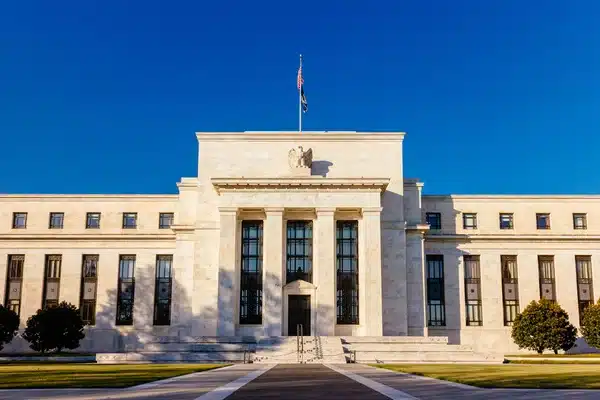
It’s been an eventful start to 2026. While lawmakers and the international community are reacting to the Trump administration’s decision to unilaterally remove Venezuelan dictator Nicolás Maduro, we’ll focus on another impending major policy decision: the leadership of the Federal Reserve.
We expect upheaval in the coming months, if not weeks, at the Fed, where Chairman Powell’s tenure as chairman will end in May. Powell will have two years left in his term on the Board of Governors after his tenure as chair ends. He could, therefore, continue on as a governor — or he could elect to leave the bank altogether. If Powell steps down, President Donald Trump would have two options:
- He could elevate a current Fed governor to be chair (an act that would require Senate approval) and nominate someone to replace Powell as a rank-and-file governor of the Fed Board (that person also would require Senate confirmation); or
- He could nominate one individual to replace Powell both as a governor and as the chair of the Fed Board.
In order to avoid two separate Senate nomination fights, and to ensure a loyalist is at the helm of the Fed, President Trump is more likely to select the second option. This week, we examine what a Powell departure could mean in terms of Fed policy and who may replace him.
But, first, the primary question:
Will Jerome Powell Stay or Will He Go?
“Powell has so far repeatedly refused to say whether he will remain with the Fed,” CNBC noted last week. “It’s a key question being asked on Wall Street for 2026 as Fed watchers try to game out whether appointees of President Donald Trump will have control of the Fed’s Board of Governors.”
As CNBC also reported, Powell’s most recent pronouncement came at a press conference late last year where he stated, “I’m focused on my remaining time as chair. I haven’t got anything new on that to tell you.”
According to the Washington, D.C. rumor mill, Powell may make that news in the coming week or two. Weighing on Powell’s mind as he makes this decision, CNBC said, were his loyalty to the institution. Powell has served at the Fed for 13 years and clearly has concerns about the economic impact of President Trump’s desire to rapidly cut interest rates Fed independence in general. The fact that Powell has been the subject of “withering public criticism,” led mostly by President Trump, over the majority of the last eight years, also will be a major factor in his decision.
To that second point: over the holidays, President Trump threatened to bring a lawsuit against Powell for “gross incompetence” regarding renovations to Fed headquarters. “[T]he guy’s just incompetent,” President Trump said during a press conference with a foreign leader. “There’s nothing you can do about it.”
For Fed watchers, recent past precedent offers some guidance as to whether or not Powell will stay. CNBC explained that Chairs Ben Bernanke and Janet Yellen “slid quietly off the board into other government positions, retirement, or the private sector with time remaining on their governor terms.” (President Trump is, of course, unlikely to choose Powell for any other role in his administration.) In the history of the Fed, only one chair, Marriner Eccles, stayed on as governor when his term in the leadership position ended.
That was 1948.
Our bet, and the consensus of Fed watchers interviewed by CNBC: Powell departs fully in May.
What Happens If Jerome Powell Leaves the Fed?
It is important to remember that, like the rest of the fed governors, the chair of the Board wields only a single vote on monetary policy matters. Here is who would, or could, remain on the Board of Governors after a Powell departure:
- Stephan Miran, a Trump nominee, whose term ends this month, but who can remain on the Board of Governors until his seat is filled.
- Christoper Waller, who was nominated by President Trump during his first term. Waller’s term expires in January 2030.
- Michael Barr, who was nominated by former President Joe Biden and whose term ends in January 2032.
- Michelle Bowman, who was nominated as a governor by President Trump in 2018 during his first term and elevated to vice chair last year. Her term as vice chair ends in June 2029. Her term as governor ends in January 2034.
- Philip Jefferson, a Biden nominee. Jefferson’s term as vice chair ends in September 2027. His term as governor ends in January 2036.
- Lisa Cook, a Biden nominee, whose term ends in January 2038.
As a reminder, Fed governors can be removed by the president only ‘for cause” — serious misconduct, ethical violations, or a physical or mental inability to serve. They cannot be removed for mere policy disagreements. As long as President Trump is in office, and Republicans hold the Senate, it is unlikely that Governors Bar, Jefferson, or Cook will willingly step down.
In other words, a Powell departure may not mean a huge shift in policy. But, as Morningstar articulated yesterday, it is likely to mean more disagreement within the Board of Governors, which is somewhat unusual. According to a New York Times analysis last summer, “In recent decades, the Federal Reserve board has been near-unanimous in its rate-setting decisions. Even a single dissent from a Fed governor has been rare.” While there were 74 total dissensions between 1980 and 1993, from 1994 to 2024, there were only five. Total.
When the Board of Governors took its December 2025 interest rate vote, there were three dissents.
Morningstar expects more this year — even before Powell’s term is up in May. “The next decision to cut or hold is not likely to be simple, especially if inflation remains sticky and the job market continues to cool.” Some analysts told Morningstar those dissents “may erode the Fed’s credibility if they persist over the long term.” Alternatively, others speculated that “deepening policy disagreements could ‘be a positive’ if they’re driven by ‘diversity of thought and produce rigorous debate.’” (Analysts agreed, however, that “if politics is the key driver [of disagreement], that could damage the Fed’s credibility in the long run.”)
Who Might President Trump Nominate to Replace Powell?
President Trump appears to be focusing his favor on two individuals to replace Powell: Kevin Hassett, who currently leads the White House National Economic Council and who also served in President George W. Bush’s administration, and Kevin Warsh, who served as a Fed governor from 2006 to 2011.
In December, Investing.com analyst Lance Roberts provided insight into what each potential nominee may mean for capital markets. Key differences between the two Kevins include:
- Warsh has Wall Street experience. Hassett, an economist, has mostly served in government or in academia. (This inexperience may not doom Hassett, however. As Roberts said, “Like many Federal Reserve members, [Hassett] lacks real-world experience.”)
- Warsh is viewed as more hawkish about rising prices. “He has frequently mentioned the inflation risk associated with dovish monetary policy,” Roberts said. “Conversely, Hassett, viewed as dovish, actively advocates deeper rate cuts to stimulate growth.” Additionally, said Roberts, “Warsh adheres to a Milton Friedman-style logic: inflation is a function of excessive money-supply growth. Based on recent speeches, Hassett is focused on growth-oriented easing and is not overly concerned with inflation.” (In other words, Warsh may be more Powell-like.)
- Warsh is skeptical of quantitative easing, or QE, a tool by which a central bank creates new money to buy large quantities of financial assets. Warsh once referred to this practice as a “reverse Robin Hood” and he has said it misallocates capital from the economy to the financial markets. (com has said Hassett may be more amenable to QE.)
For bettors, Hassett was leading the probability race at the end of 2025. On December 30, Interactive Brokers put the odds of Hassett being nominated by President Trump at 43 percent. Odds for Warsh were at 35 percent. Rounding out the group: current Fed Governor Chris Waller at nine percent and current U.S. Treasury Secretary Scott Bessent at two percent.
No matter who President Trump chooses to replace Powell, the nominee will surely encounter at least some tough questions at his Senate Banking Committee confirmation hearing. Over the holidays, Ranking Member Elizabeth Warren (D-Mass.) made clear her opposition, in particular, to Hassett. “I am most worried about Kevin Hassett. … He has made clear that he will do whatever the president wants done,” Sen. Warren told CNBC. “He will say whatever the president wants said.”
For his part, Tim Scott (R-S.C.) told FOX Business he will push for an “accelerated path to completion” of Fed nominations hearings — and made it clear he prefers a chair who will favor interest rate cuts. “We need a Fed chair who puts the American people’s priorities above politics,” said Chair Scott. “We saw with Jay Powell that, with the Biden administration in office … We want someone who’s agnostic to who’s in the White House, someone who focuses on the American people’s priorities, and that means lowering interest rates, making affordability a priority and stabilizing the prices so significant that we have a Fed chair that gets the job done.”