
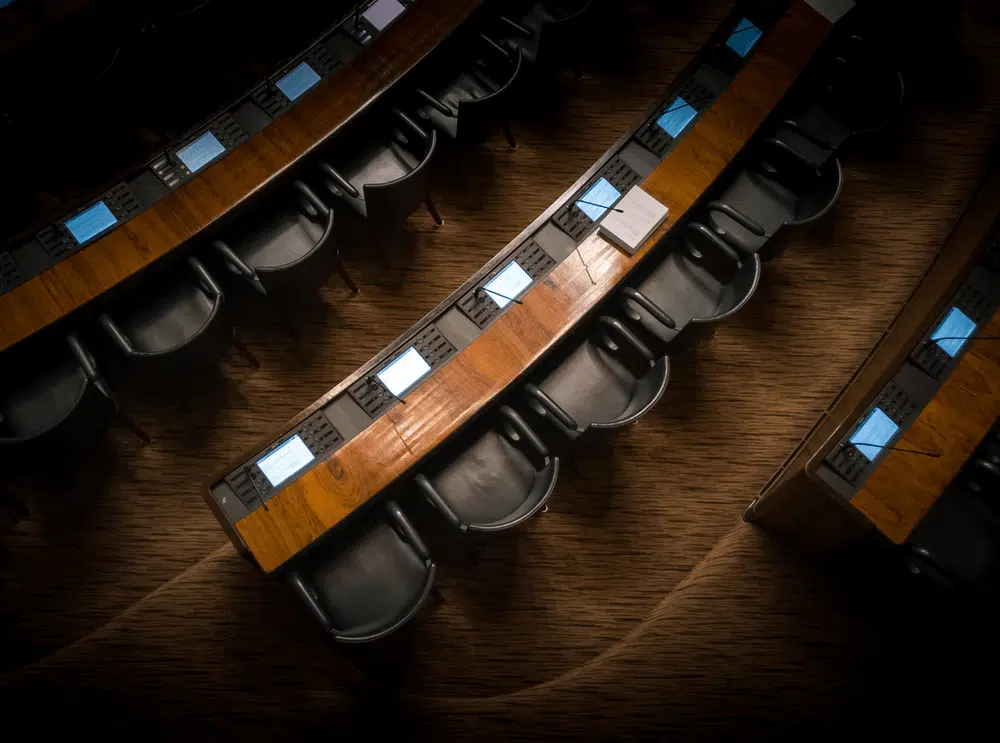
After a significant push by President Donald Trump and the White House to keep the U.S. Senate in session during August to consider and vote on his executive branch and judicial nominees, the upper chamber of Congress finally has recessed.
Kind of.
One senator remains. Sen. Mike Rounds (R-S.D.) is still in Washington, D.C., presiding over an entirely empty chamber as it remains in pro forma session.
Why is Sen. Rounds hanging around, and what’s a pro forma session anyway? Let’s take a look.
What’s a Pro Forma Session and Why is the Senate in One Now?
Both chambers of Congress may utilize pro forma sessions.
According to the nonpartisan Congressional Research Service (CRS), “in the primary sense of the term, a pro forma session is … any daily session which is held chiefly to prevent the occurrence of a ‘recess of the session’” — which is “an adjournment for more than three days.” The CRS adds that “the term is commonly used, in particular, to connote a short daily session of either chamber in which little or no business is transacted, and often also for any session for which no session of that chamber occurs on either the preceding or following day.”
In plain English, what is happening now is that Sen. Rounds will open a daily session of the Senate, recite the pledge of allegiance, but then, just a few moments later, end the daily proceedings. No other senators need to be present to witness or participate in these actions; Sen. Rounds just gavels in and then gavels out.
The primary purpose of a pro forma session is to avoid a full adjournment — senators want to be able to say the chamber is not really in recess.
Why is this elaborate show necessary right now?
Because pro forma sessions keep the president from making recess appointments.
What’s a Recess Appointment?
As the law firm Arnold and Porter has explained, “the Recess Appointments Clause of Article II of the Constitution grants the president the authority to temporarily fill vacancies without Senate approval during recesses.”
As noted, recess appointments are temporary. Indeed, they only last until the end of the Senate’s next session. Arnold and Porter noted that an individual appointed during the first session of the 119th Congress, or calendar year 2025, or the recess between the first and second sessions would serve until the end of the second session of the 119th Congress in January 2027. A person appointed during the 119th Congress’s second session, or next year, would serve until the end of the first session of the 120th Congress in December 2027.
U.S. presidents have used recess appointments for both executive branch nominations (individuals who serve in federal agencies like the U.S. Department of the Treasury and the U.S. Department of Defense) and to fill vacancies for U.S. courts, even though judges are supposed to serve lifetime appointments. “Beginning with George Washington, almost every president filled judicial vacancies by recess appointments, without suggestion from any quarter that the practice violated the Constitution,” explained Fourth Circuit Court of Appeals Judge Diana Gribbon Motz in a 2011 lecture at the University of Virginia’s law school.
That changed during the middle of the 20th century. After President Dwight D. Eisenhower made three recess appointments to the U.S. Supreme Court — for Chief Justice Earl Warren, and for Justices William J. Brennan and Potter Stewart — senators started to raise questions about the practice, Judge Motz said, issuing a report that concluded recess appointments should only be made under unusual circumstances.
Did future presidents listen? Not really.
Recess Appointments Proliferate Between 1980 and the Early 2000s
According to a Congressional Research Service report issued in 2005:
- During his two terms in office, President Ronald Reagan made 240 recess appointments;
- President George H. W. Bush made 77 recess appointments during his four years in office, 1989 to 1993; and
- President Bill Clinton made 140 recess appointments during his eight years in office.
Arnold and Porter reported that President George W. Bush made 171 recess appointments. To illustrate the limited nature of recess appointments, CRS explained how this tool affected the terms of two federal judges. Specifically:
- On January 16, 2004, during the recess between the first and second sessions of the 108th Congress, President Bush recess-appointed Charles W. Pickering to the U.S. Court of Appeals for the Fifth Circuit. Pickering’s appointment expired on December 8, 2004, at the end of the second session of the 108th Congress.
- On February 20, 2004, President Bush recess-appointed William H. Pryor to the U.S. Court of Appeals for the Eleventh Circuit. This recess appointment took place during a 10-day adjournment of the Senate within the second session of the 108th Congress. Consequently, Pryor’s recess appointment expired at the end of the first session of the 109th Congress.
Recess appointments slowed down after President George W. Bush’s second term. Indeed, President Barack Obama only made 32 recess appointments.
But it wasn’t because the White House had suddenly lost the appetite for using this tool.
The U.S. Supreme Court Steps in to Curb Recess Appointments
In 2014, the U.S. Supreme Court issued a decision in National Labor Relations Board v. Noel Canning. As the legal website Oyez explained, four years earlier, Noel Canning, a bottler and distributor of soft drink products, agreed to submit two separate wage and pension plans to a vote by its employee union membership. Noel Canning employees approved one of the proposals — the one favored by the union. The company argued that the discussions leading up to the vote, and the vote itself, did not amount to a binding agreement. As such, executives refused to incorporate the changes into the employees’ new collective bargaining agreement.
The union filed a complaint with the National Labor Relations Board (NLRB), and the NLRB ruled in the union’s favor.
Noel Canning then appealed to the U.S. Court of Appeals for the District of Columbia Circuit, arguing the NLRB’s ruling was invalid because not enough members of the board were present for the vote. (To hear a case and issue a ruling, the NLRB must have at least three of its five members present.) The appeals court agreed — not because there were not three NLRB judges present, but because two of those officials had been appointed by President Obama via recess appointment during pro forma sessions.
The case eventually made it to the Supreme Court, where the question before the justices was two-fold:
- Was the Senate actually “in recess” when President Obama appointed three people to the Board on January 4, 2012; and
- Does the Constitution’s Recess Appointments Clause grant the president the power to fill only vacancies that occur during the official recess of the Senate?
In a 9-0 decision, the justices answered no to both questions. More specifically, and for the purposes of this current August recess, “The Court held that a pro forma session does not create a recess long enough to trigger the Recess Appointments Clause,” Oyez explained.
Does the fact that the Supreme Court has spoken on the constitutionality of pro forma session recess appointment mean this is the last we will hear of this issue?
Definitely not.
As AXIOS reported last week, Senate Republicans are eyeing rules changes to counter Democrats’ stonewalling of civil nominee confirmations, and while it is so far “unclear what exact changes they’ll pursue,” options include:
- Eliminating procedural votes on nominees;
- Shortening debate time on the Senate floor;
- Voting on nominees en bloc (meaning, packaging several, even dozens, of nominees together); and
- Shortening the list of executive branch positions that require Senate confirmation.
In other words, while the floor during Sen. Rounds’ pro forma sessions may be quiet right now, we can expect some fireworks come September.