
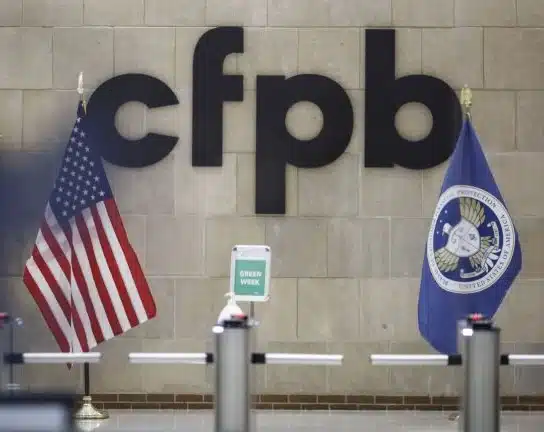
The Board of Tea Appeals. The Reconstruction Finance Corporation. The Office of Technology Assessment. And the Federal Theatre Project. These were all once federal agencies — until they were abolished by an act of Congress.
Is the Consumer Financial Protection Bureau (CFPB) about to join them? President Donald Trump has made it clear that he thinks it should, but does he have the power to get rid of the CFPB, and what happens if he does?
A Short History Of Lost Federal Agencies
“Congress has, from time to time, enacted legislation to discontinue a federal agency and either redistribute or discontinue its functions,” the Congressional Research Service (CRS) explained in a January 2024 report. “Abolishment of an agency or its functions has often been politically challenging because of the potential impact on stakeholders with competing interests.”
Indeed, more than four dozen federal agencies have been established by Congress and later permanently closed, or their duties collapsed into another agency. Like the Federal Theater Project (FTP), a New Deal program that funded live artistic performances and entertainment programs across the United States, many of these agencies were meant to help the country and its citizens through the Great Depression and were abolished once that economic crisis was over. (The FTP was especially short-lived, however, since Congress was worried about “Communist infiltration” of the Project. Lawmakers pulled funding after just four years.)
Another lost federal agency is the Interstate Commerce Commission (ICC), established by Congress in 1887. Policymakers worried about monopolistic behavior by rail titans sought to regulate railroads, ensure fair shipping rates, and eliminate rate discrimination. The CRS report referenced above called the story of the ICC “perhaps the quintessential example of the abolishment of an agency and discontinuation of many of its functions.”
Why? Because it is marked by a stark rise and fall. The ICC “was statutorily established in 1887, grew to be a powerful regulatory agency with far-reaching authority, declined in stature and authority, and was ultimately abolished by Congress in 1995.” Along the way, its activities were criticized by: scholars, including a former law school dean appointed by President John F. Kennedy; a presidentially appointed committee that examined independent regulatory commissions; transportation experts; and Presidents Richard Nixon and Ronald Reagan. President Reagan’s fiscal year 1987 budget included the ICC among “government programs [that] have become outmoded, have accomplished their original purpose, represent an inappropriate area for federal involvement in the first place, or are marginal in the current tight budgetary environment.”
This scenario sounds all too familiar.
Could A Legal Loophole Lead To The CFPB’s Demise?
Republicans have opposed the CFPB since it was established by the 2010 Dodd-Frank Wall Street Reform and Consumer Protection Act. For example, in February 2017, former U.S. House Financial Services Committee Chairman Jeb Hensarling, who is no longer in Congress, penned an op-ed in The Wall Street Journal that argued, “The CFPB has eroded freedom, trampled due process and killed jobs. It must go.”
Harsh words.
As CNN has explained, Republicans believe the CFPB is “a ‘rogue’ agency because it’s not funded by Congress, and it’s run by a single director who can’t be fired by the president at will.” During President Trump’s first term, GOP representatives brought constitutional challenges to the CFPB on both grounds. They garnered a partial win in the case involving the question of a single director: a Supreme Court decision allowed the president to fire the director, but it also kept the Bureau open. In another Supreme Court regarding the Bureau’s funding structure, Republicans lost.
The question about funding came up again this month — and the now GOP policymakers believe they may have found a loophole that would allow them to shut down the Bureau.
In a November 10 court filing, the U.S. Department of Justice’s (DOJ) Office of Legal Counsel (OLC), a division that provides legal advice to the president and other executive branch officials, argued the CFPB’s current method of funding is unlawful. More specifically, the OLC said, in the current context, the CFPB cannot draw money from the Federal Reserve because the Bureau is only entitled to Fed surpluses – and the country’s central bank has operated with a deficit since 2022.
The Trump administration’s filing estimated the CFPB has enough money to last “at least” through the end of 2025, but that it “anticipates exhausting its currently available funds in early 2026.” Politico explained what this scenario means practically: “The move would leave the CFPB without money to operate starting next year, even to carry out its required activities, unless Congress passes fresh funding for the agency. That is unlikely, given widespread Republican opposition to the CFPB.”
Adding to this odd turn of events, late last night President Trump nominated Stuart Levenbach, an employee at the Office of Management and Budget with no financial services experience, to serve as full-time CFPB director. Levenbach’s appointment is likely an effort to keep current Acting Director Russ Vought in place until the administration can successfully shut down the Bureau. (Vought is serving under the Federal Vacancies Reform Act of 1998, which says an acting director can serve for a maximum of 210 days from the date the vacancy occurs, or only if a nomination for the position is pending in the Senate. Vought has been Acting Director since February 7. Without a nominee, his term would soon expire.)
Without additional funding, the Bureau would lack sufficient resources to maintain staffing and keep its regulatory and enforcement operations running. A funding lapse could freeze ongoing rulemakings, delay supervisory examinations, and halt new enforcement actions, injecting substantial uncertainty into the consumer finance regulatory landscape.
The OLC decision is almost certain to be challenged in court by CFPB supporters — precisely because Congress has given the Bureau very specific duties that it is supposed to carry out on behalf of the American people.
The Statutory Duties Of The CFPB
As a February 2025 Consumer Federation of America (CFA) fact sheet explained, the CFPB has “many responsibilities and obligations that [it] is legally obligated to perform.” Indeed, the CFA identified 87. The Bureau itself has explained these duties fall into six core functions, which are:
- Rooting out unfair, deceptive, or abusive acts or practices by writing rules, supervising companies, and enforcing the law;
- Enforcing laws that outlaw discrimination in consumer finance;
- Taking consumer complaints;
- Enhancing financial education;
- Researching the consumer experience of using financial products; and
- Monitoring financial markets for new risks to consumers.
Going back to the CRS report on the Interstate Commerce Commission, it would appear that, if the Trump administration goes ahead with its plan to shut down the CFPB, Congress would have two choices when it comes to these functions.
First, “where a determination has been made that the federal government will continue to carry out the agency’s functions, Congress has often transferred these to new or existing government or quasi-governmental organizations,” CRS explained. This scenario played out in 2002 when Congress abolished the Immigration and Naturalization Service, which was part of DOJ, and transferred its statutory functions to different entities within the newly-created U.S. Department of Homeland Security.
“At other times, Congress has abolished an agency in the context of a broader congressional assessment of the policy area(s) covered by the agency and the authorities it has exercised,” CRS noted. “In such cases, Congress has not only abolished the agency, but it has repealed, without replacement, the statutes underlying some or all of the agency’s authority and discontinued or greatly reduced the functions the federal government would continue to carry out.”
While Republicans control both the U.S. House and Senate, that second option still may be a nonstarter. Legislation to abolish the agency and its statutory functions would be filibustered by Democrats in the Senate, where Republicans lack the two-thirds votes necessary to invoke cloture.
Amidst this backdrop, momentum may build on Capitol Hill to change the CFPB’s funding structure to have it rely on appropriations, which has long been a priority for the GOP. Or Republican lawmakers could advance legislation to shut down the agency, but have other entities carry out its duties.
Only time will tell what approach lawmakers take. While shuttering the CFPB proceeds with apparent haste, the campaign to shut down the ICC took more than a quarter of a century to succeed. “The case of the ICC illustrates that the abolishment of an agency and its functions — particularly one as powerful and integrated into American life as the ICC once was — can be a complex, multifaceted, incremental, and lengthy legislative and administrative process,” CRS concluded.