
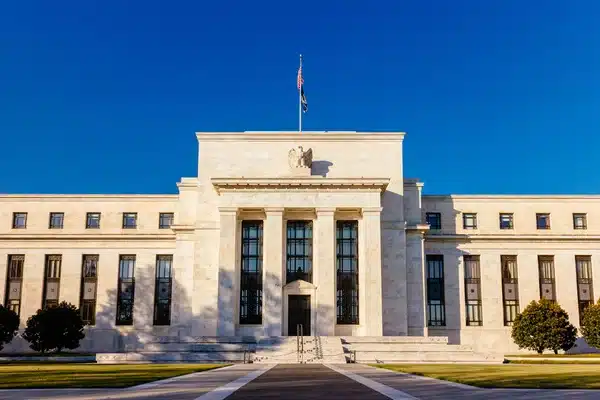
The Federal Reserve’s Federal Open Market Committee (FOMC) will meet again at the end of this month. At that time, its members will determine whether to reduce the federal funds interest rate or to keep it where it is. FOMC members, especially Chair Jerome Powell, have been under increasing pressure from President Donald Trump to cut the rate in order to reduce borrowing costs for American consumers.
These days, however, interest rates aren’t the only issue weighing on Powell. Republicans have been increasingly vocal in their criticisms of the Fed Chair with regard to renovations at the Fed’s Washington offices. GOP lawmakers argue the Fed chair has spent too much money, and they cite mismanagement of the construction as just one more reason President Trump should fire Powell.
All of this begs several questions. Can the president of the United States actually fire the Fed chair — a role that is supposed to be outside the influence of politics? What would the termination of Powell signal about Fed independence more generally? And, if President Trump does fire Powell, who is he likely to choose as his new Fed chair nominee?
Let’s take a look.
Can A U.S. President Fire The Fed Chair?
Chair Powell has been a thorn in President Trump’s side for some time. In fact, back in September 2019, during President Trump’s first term, the Brookings Institution took a look at what would happen if the president tried to fire Powell.
At that point, scholar Peter Conti-Brown asked: can President Trump even fire Powell?
The answer is no, yes, or maybe.
As Conti-Brown noted, Powell holds not one, but three roles: he is a member of the Federal Reserve’s Board of Governors — a position that is appointed by the president and confirmed by the Senate; he is chair of the Board of Governors — a role that is separately appointed by the president and confirmed by the Senate; and he is chair of the FOMC.
On the “no” side: That third role, chair of the FOMC, is approved by a vote of the members of that committee. President Trump cannot simply tell Powell he no longer heads the FOMC and choose someone else.
On the “maybe” side: federal law is silent regarding whether the president can fire the chair of the FOMC, or, effectively demote that person to being simply one of the other governors. “Other presidents have concluded that they lacked that authority,” Conti-Brown wrote, “And there is good reason to think they were right. But we just don’t know: it’s legally uncertain.”
On the “yes” side: Under federal law, to remove a member of the Board of Governors, the president has to have “cause” to do so. Historically, Conti-Brown explained, courts have interpreted cause “as requiring ‘inefficiency, neglect of duty, or malfeasance in office.’ Policy differences are not enough justification.”
In other words, removing Powell from the Board of Governors because he refuses to reduce interest rates is off the table.
But if Powell has mismanaged the Fed’s budget? Well, that’s another story.
Indeed, here’s how The Associated Press framed questions about the cost of the Fed’s renovation project in an article this morning: “President Donald Trump says he has finally found a way to achieve his goal of removing Powell, accusing him of mismanaging the U.S. central bank’s $2.5 billion renovation project.”
The Trump administration is also trying to lay out other potential legal predicates to fire Powell for cause, arguing that he not only misspent funds, but lied to Congress in committee testimony about the project. In a letter to Powell last week, Office of Management and Budget Director Russell Vought outlined these arguments. Then he went on CNBC and said, “When you go to the nation’s mall, you see the construction of this palace … upwards of $2.5 billion massive cost overrun … I think it just points to the fundamental mismanagement of the Fed under the chairman.”
Why Is The Fed Supposed To Be Independent?
Regardless of whether President Trump finally has “cause” to fire Powell, many observers believe that the termination of Powell is a threat to the Fed’s independence, a concept that dates back to the 1950s. (The Fed itself was established in 1913.)
Around 1950, members of the Fed came to believe that its method of setting interest rates was fueling inflation. But Treasury Secretary John Snyder, a close ally of President Harry Truman, insisted that the Fed not alter policy and keep interest rates fixed in order to keep government borrowing costs low.
The disagreement reached a boiling point a year later.
Like President Trump, President Truman was alarmed by high interest rates. In January 1951, he summoned Fed officials to the White House, pleading with them to lower rates. The Fed resisted, leading to a public showdown that ultimately led to the resignation of the Fed chair.
President Truman nominated a former Treasury official whom he hoped would lower rates, but that chair, William McChesney Martin, surprised the president by arguing that the Fed should not bow to political persuasion. The standoff was settled on March 4, 1951, when the Federal Reserve and the Treasury Department issued a joint statement, now known as the Fed-Treasury Accord, which formally ended the Fed’s obligation to maintain a fixed interest rate on government bonds. Under the accord:
- Treasury acknowledged that the Fed would no longer peg interest rates to support Treasury financing.
- The Fed regained full control over open market operations, allowing it to raise rates to combat inflation without Treasury influence.
- The administration agreed to establish a clear institutional boundary between the Treasury (responsible for fiscal policy) and the Fed (responsible for monetary policy).
The Accord was a watershed moment for the Fed’s independence, and formed the basis of the idea, still held today, that the Fed should be immune from political influence when setting monetary policy. Fed Chair Martin, who led the agency until 1970, famously said the central bank’s job was to “take away the punch bowl just as the party gets going,” a reflection of the Fed’s newfound responsibility to act counter-cyclically, even when it meant unpopular decisions.
Powell clearly is unpopular in GOP circles, but who would replace the Fed chair if President Trump does opt to remove him?
Who Might Replace Powell If He Is Fired?
President Trump has said his next Fed chair will be “somebody who wants to cut [interest] rates.”
One of the top contenders to achieve this goal appears to be U.S. Treasury Secretary Scott Bessent, but, according to The Hill, Bessent would not leave his job at the Treasury. He would serve in both roles, and that option may be perfectly legal. “There’s no prohibition in the Federal Reserve Act that says a member of the board of governors, or the chair, can’t also be the Secretary of the Treasury,” Sarah Binder, a senior fellow at the Brookings Institution, told The Hill. The newspaper noted Treasury secretaries sat on the board of the Fed prior to 1935.
Still, this option could make policymakers, business leaders, and markets uncomfortable. “[H]aving a dual Fed-Treasury chief would fly in the face of the doctrine of central bank independence that has gotten stronger over the years,” The Hill wrote. “Specifically, it would undermine a semiformal 1951 agreement between the two entities that separated the duties of public debt issuance from interest-rate setting.” (The agreement referenced earlier in this post.)
Another candidate for Fed chair is White House National Economic Council Director Kevin Hassett, who served as President Trump’s chair of the Council of Economic Advisers during his first term. “His resume is stacked with academic credentials, private-sector experience, and deep connections in conservative economic circles,” Quartz said. “More importantly, perhaps, is that he’s remained one of the rare economic figures to retain Trump’s trust across both political campaigns and administrations. That loyalty could prove decisive.”
A third candidate is Kevin Warsh. Warsh served on the Fed Board of Governors from 2006 to 2011. He was interviewed by President Trump for the Fed chairmanship during the president’s first term, before President Trump eventually went with Powell. “Warsh is well spoken and photogenic, qualities Trump values,” the Scotsman’s Guide wrote. “On the downside for his candidacy, he gained a reputation as being a policy ‘hawk,’ meaning he has worried more about inflation than the labor market and has advocated in the past for raising interest rates to combat inflation.”
So far, however, Powell has continued to fight for his job. The Fed has published a webpage regarding its headquarters renovation that attempts to counter some of GOP lawmakers’ most significant accusations. Additionally, Powell has said he would file a lawsuit challenging any decision to fire him.
There is yet another option, of course.
During an interview yesterday with Bloomberg TV, Secretary Bessent suggested Powell should step down from the central bank’s board when his term as chair expires in May 2026. (Powell’s term as a Fed governor expires in January 2028.)
Is President Trump willing to wait another 10 months? Chances are, we’ll know the answer to that question soon.