
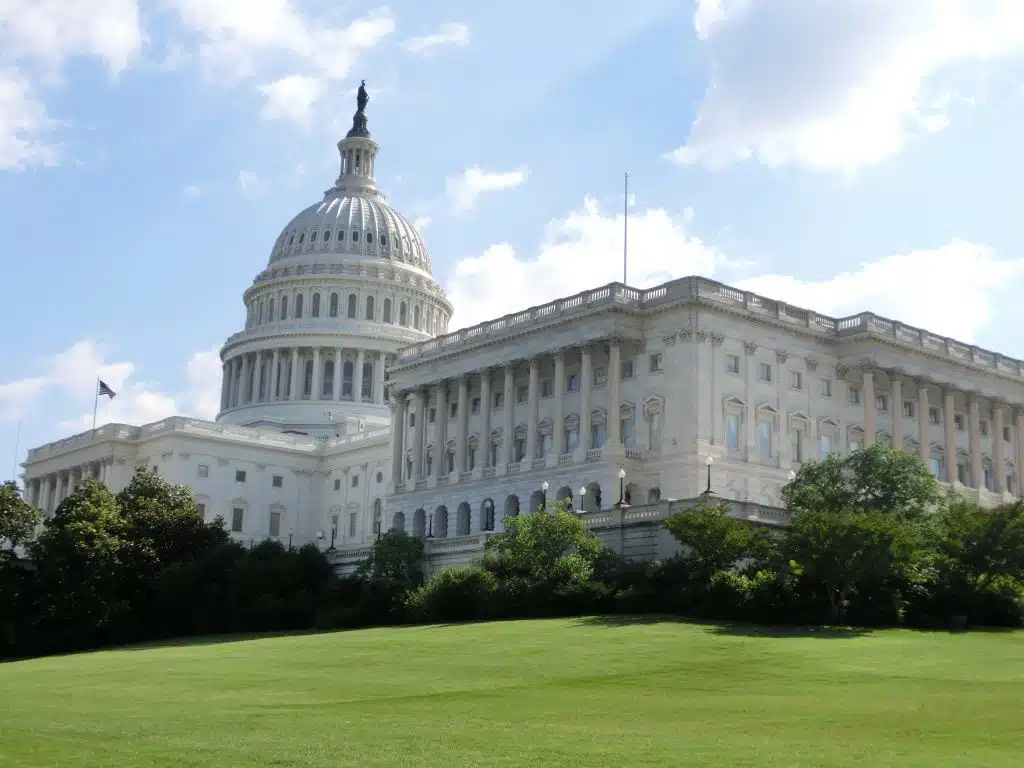
Late yesterday afternoon, the U.S. House of Representatives approved a continuing resolution (CR) that will keep the federal government funded through the end of fiscal year (FY) 2025. The virtually-party line vote was 217 to 213. Rep. Thomas Massie (R-Ky.) was the only Republican to vote against the legislation while Rep. Jared Golden (D-Maine) was the only Democrat to vote for it.
Approval of the measure gets lawmakers one step closer to avoiding a government shutdown, but there is, of course, still a possibility this bill will not make it to President Donald Trump’s desk before funding runs out this Friday, March 14 at 11:59 p.m. ET. Indeed, the Senate needs to consider the measure and, in that chamber, the CR will need the support of at least seven Democrats to overcome the 60-vote filibuster threshold — or eight Democrats if Sen. Rand Paul, Republican from Kentucky, makes good on his threats to vote against the measure.
What does the legislation contain and what is the likelihood Senate Majority Leader John Thune (R-S. Dakota) will pick up seven or eight Democratic votes?
Let’s take a look, but first: why did Democrats oppose a bill that would keep federal agencies’ doors open and serving the American people?
What Democrats Want From A FY 2025 Funding Bill
House Democrats do not want a government shutdown. As The Hill explained, what the minority party was trying to extract from Republicans prior to the House vote was a shorter-length CR so lawmakers could take a more surgical approach to funding for each federal department and agency. (For what it’s worth, House Speaker Mike Johnson, Republican of Louisiana, has pledged many times not to rely on CRs or omnibus spending bills. Indeed, in November 2023, he said, “I hate CRs as much as everyone does. It is not the way you’re supposed to do it. And we’re going to get right back to the regular budgeting process … We’re going to start that next year. We’re not going to do this again. We’re not doing this under my leadership.”)
Democrats also wanted more funding for priorities like the National Institutes of Health, nuclear weapons proliferation programs, agricultural research and farmer assistance, and the Internal Revenue Service. Additionally, members of the party were hoping Republicans would agree to some guardrails for the Department of Government Efficiency (DOGE) and, in response to the ever-growing list of federal agencies at which the administration has directed mass layoffs, language that would require President Trump to direct funds as appropriated by Congress.
House Democrats also wanted language in the bill to protect Social Security, Medicare, and Medicaid even though those programs are not funded through the annual appropriations process. (In a recent television interview, Musk suggested he wanted to cut Social Security by $600 billion or $700 billion a year.)
Republican lawmakers, of course, did not agree to any of those requests. Indeed, as The Hill noted, “Republicans — many of whom are typically averse to continuing resolutions (CR) — rallied around the stopgap in the name of DOGE continuing its work.”
What Does The Continuing Resolution Do?
The CR sets discretionary spending levels for FY 2025. (Note: the federal government already is halfway through FY 2025, which started Oct. 1, 2024, and ends Sept. 30, 2025.) While full-year CRs are rare, this certainly would not be the first one Congress ever has approved. According to the Peter G. Peterson Foundation, Congress adopted full-year CRs in FYs 2007, 2012, and 2013.
Broadly, the legislation increases defense spending while keeping overall spending close to FY 2024 levels. More specifically, as The New York Times and other news outlets have explained:
- Spending for the military would increase by $6 billion;
- Spending for non-defense programs would fall by about $13 billion, not counting funding for immigration programs, which would receive a boost;
- The bill does not include funds for any projects in lawmakers’ districts or states, known colloquially as “earmarks”;
- The bill revokes billions of dollars Democrats secured outside statutory spending caps last year for Energy Department and Environmental Protection Agency programs;
- Army Corps of Engineers projects that manage flood risks, restore ecosystems, and maintain water infrastructure would lose $1.4 billion, a 44 percent reduction; and
- Local lawmakers in Washington, D.C. would be forced to cut $1 billion from their budget for the city. (Congress oversees spending for the nation’s capital.)
Republicans also gave the U.S. Department of Defense some flexibility to start new programs and move funds around — leeway not allowed to other agencies. (According to Roll Call, the CR also includes $1.5 billion for a warship the U.S. Navy has not even requested.)
While Republicans called the measure “clean” — meaning it simply provides funding and does not set policy on other matters — there is some non-appropriations related language in the bill. For example, the CR extends telehealth flexibilities for Medicare beneficiaries and providers, allowing telehealth visits to be conducted from an expanded list of locations, including the patient’s home. It also extends authorization for the National Flood Insurance Program until Sept. 30, 2025.
The Continuing Resolution Still Faces A Tough Road
All eyes are now on the Senate’s 47 Democrats, and how they will vote on the CR. Indeed, according to The Hill, Democrats “battled behind closed doors” yesterday about whether or not to support what most in the party called “a horrible bill.”
A few Senate Democrats already have stated plainly there is no way they will vote for the CR. “This is a shutdown bill that’s bad for the economy — let Trump shutdown whatever he wants, hurting everyday folks to use money for tax breaks for the uber-rich,” Sen. Tim Kaine (D-Va.) posted on Elon Musk’s X earlier this week. “Hell no!”
Yesterday, Sen. Chris Van Hollen (D-Md.) said voting for the measure would make Democrats “complicit” in carrying out the Trump administration agenda.
But The Hill also reported there is growing sentiment in the party to vote for the CR anyway. Punchbowl agreed. “The prevailing belief after the [Tuesday] meeting, according to an attendee and several people briefed on it, was that a shutdown would be a lose-lose situation for Senate Democrats. They’d get the blame and, even worse, there would be no clear path out of a shutdown,” the Washington, D.C.-based newspaper concluded this morning. Sen. John Fetterman (D-Penn.) has said he will vote yes on the CR, but “Senate Democratic Leader Chuck Schumer (D-N.Y.) declined to comment about what he and his colleagues discussed in private,” The Hill reported.
According to a separate report in The Hill published earlier this week, there is growing anxiety among Senate Democrats about the practical, not just political, repercussions of a shutdown. Specifically, some fear a shutdown could backfire by supercharging Elon Musk’s efforts to gut the federal workforce. (More on the connection between firing government workers and a government shutdown in a moment.) “Who knows what he’s going to want to open back up? That is a huge risk,” Sen. Mark Kelly (D-Ariz.) said. “Maybe they decide that entire government agencies don’t need to exist anymore.”’
Other senators echoed these worries. While he did not say exactly how he will vote when the Senate takes up the CR, Sen. Angus King (I-Maine), who usually votes with Democrats despite being an Independent, also is wary of Musk’s intentions. “We’re dealing with people, many of whom I suspect, think a shutdown would be a good thing, and they could prolong it and use it to expand the president’s power even beyond what they’re already considering. So that’s something that has to be considered,” Sen. King told The Hill. “This isn’t normal.”
According to a report earlier this week, Sens. Kelly and King’s worries may be well founded. WIRED magazine reported yesterday that Elon Musk has stated privately that he wants a shutdown because he believes a work stoppage will make it easier to fire federal government employees. “A shutdown has been his [Musk’s] preference,” one anonymous Republican told WIRED. “A second Republican who had heard about Musk’s desire for a government shutdown” told Wired “the billionaire’s goal is for the continuing resolution … to tank, if only to achieve a brief government shutdown.”
Would a shutdown make it easier to fire workers? It appears so.
“Once federal employees have been furloughed for more than 30 calendar days, that furlough becomes subject to a reduction in force (RIF),” Nick Bednar, a professor at the University of Minnesota School of Law, told WIRED. “This means that after 30 days, furloughed employees are automatically kicked into RIF procedures, which prioritizes retaining employees by seniority and whether that individual is a veteran.” Don Moynihan, a professor of public policy at the University of Michigan, agreed. He told WIRED, “A shutdown is aligned with the goals of DOGE.”
So, what will Senate Democrats do? They have about 48 hours to decide.