
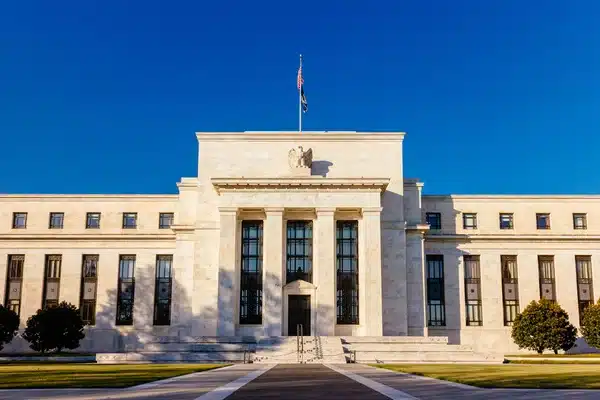
The Fed cut the federal funds rate by 50 basis points last week. How quickly will additional rates cuts come?
The Federal Reserve’s Open Market Committee (FOMC) surprised quite a few prognosticators last Wednesday when it reduced its benchmark federal funds rate by half a percentage point. The consensus forecast largely had been that the FOMC would lower rates by a quarter point.
Not all FOMC members were on board with the larger cut, however. The vote was 11-1. Governor Michelle Bowman preferred the quarter-point move. Her dissent was the first by a Fed governor since 2005.
It took about two minutes for analysts to begin parsing what the Bowman dissent meant and what Chairman Jerome Powell and his fellow FOMC officials had signaled in their accompanying statement about the central bank’s future plans. Indeed, markets were very choppy as the world reviewed the statement. The Dow Jones Industrial Average increased 375 points after the rate cut was announced, but those gains eventually vanished…until the following day.
As AXIOS explained earlier this week, there are two basic arguments in favor of future rate cuts. The first is that because inflation is now close to the Fed’s target, it is no longer necessary or appropriate to have rates set at the higher levels meant to dampen consumer demand. The second theory, AXIOS said, “is that the labor market has been steadily worsening for months now, so the Fed needs to take action to prevent it from sliding further.”
Do the members of the FOMC buy into either of these theories?
Let’s take a look.
What Did The FOMC Signal About The Future?
Analysts generally believe the FOMC will cut rates again when it meets next on November 6-7. (That’s right: the FOMC’s next meeting will start the day after voters go to the polls for the 2024 election.) But, again, the question is by how much.
As CNBC reported, the FOMC’s “dot plot,” which shows the projected year-end target range for the federal funds rate from each of the 19 FOMC meeting participants, predicts the equivalent of 50 more basis points of cuts by the end of 2024, probably coming in two tranches: a quarter-point cut at the November meeting and then another quarter rate reduction when the FOMC meets the week before Christmas.
This “dot plot” matrix also pointed to another full percentage point in cuts by the end of 2025 and a half-point reduction coming in 2026. In all, the dot plot shows the benchmark rate coming down about two percentage points over the next 18 months beyond the rate cut the FOMC enacted last week.
On Monday, Chicago Federal Reserve Bank President Austan Goolsbee made it clear he thinks many more rate cuts are coming. In fact, according to Politico, he said, “As we’ve gained confidence that we are on the path back to two percent [inflation], it’s appropriate to increase our focus on the other side of the Fed’s mandate — to think about risks to employment. That likely means many more rate cuts over the next year.” Goolsbee also said he estimates the Fed’s current benchmark interest rate is “hundreds” of basis points above neutral, the level at which policy neither stimulates nor restricts economic growth.
Meanwhile, Atlanta Federal Reserve Bank President Atlanta Raphael Bostic told Bloomberg that smaller-sized rate cuts would “belie growing uncertainty about the trajectory of the labor market.” Bostic also said, “On the employment side of the ledger, clearly the red-hot job growth coming out of the pandemic is cooling.”
Minneapolis Federal Reserve Bank President Neel Kashkari also made his stance plain this week. “In my judgment, cutting the policy rate by 50 basis points last week was the right decision — one that reflects both the substantial progress we’ve made in lowering inflation and also the softening of the labor market,” Kashkari said in an essay on the Minneapolis bank’s website. “Even after that cut, the overall stance of policy remains tight. Our path forward will depend on the totality of the incoming data for economic activity, the labor market, and inflation.”
As AXIOS noted, even Fed Governor Michelle Bowman, who, as noted above, formally dissented from last week’s decision, made clear in a statement released Friday that she agreed it was time to cut rates. She just wants to move more slowly. “We have not yet achieved our inflation goal. I believe that moving at a measured pace toward a more neutral policy stance will ensure further progress in bringing inflation down to our two percent target. This approach would also avoid unnecessarily stoking demand,” Bowman said.
Still, unlike Bowman, most FOMC officials clearly think unemployment is more of a worry at this point than inflation. In their statement last week, the FOMC predicted the nation’s jobless rate will rise this year to 4.4 percent. In June, they had predicted it would hit four percent. (The country’s jobless rate currently is 4.2 percent.) The FOMC also lowered its consensus inflation prediction to 2.3 percent from 2.6 percent.
Analyst Predictions For Future Fed Policy
Michael Feroli, who is JPMorgan Securities chief U.S. economist and one of the few analysts who predicted the FOMC would cut rates by half a percentage point last week, told Bloomberg Television he believes it is possible the FOMC could cut rates another 50 basis points at its November meeting.
Feroli was quick to say that prediction is contingent on the next two U.S. employment reports, which will be released on October 4 and November 1. The moderators asked Feroli under what circumstances exactly the FOMC would consider moving down another half point as opposed to a quarter point.
“If we were to see another two-tenths move up [in the unemployment rate] in those next two reports, I think then it becomes an interesting meeting,” Feroli said. “I think if we start to see private payrolls break below 100k, or further below 100k, like they have been doing, I think that would also be something” where the committee would have to reassess their plans for a quarter-point reduction.
Other analysts think that while the FOMC may cut rates again in November, that reduction might be all consumers see. Last Friday, “Experts who spoke to ABC News predicted that the Fed is all but certain to deliver at least one more interest rate cut this year,” but “voiced caution about the forecast for rate cuts next year, saying the path would depend on economic performance, which is difficult to anticipate.”
“These long-term interest rate projections are almost never correct,” Derek Horstmeyer, a finance professor at George Mason University, told ABC News.
Still, Fitch Ratings expects the federal funds rate to fall to 4.5 percent by the end of 2024, 3.5 percent by the end of 2025, and three percent by June 2026. Fitch concluded, “The scale of the U.S. Federal Reserve’s interest rate cuts in this monetary policy-easing cycle is still likely to be modest in comparison with historical rate-cutting episodes, despite the larger-than-expected cut at last week’s FOMC meeting.”
That statement begs the question: what does history indicate about what the FOMC might do next?
Does The FOMC Usually Cluster Rate Cuts?
As we noted last week, the last time the FOMC cut rates was in early 2020, at the beginning of the COVID-19 pandemic. In that incredibly unique and short-lived rate-cut environment, the FOMC only reduced rates twice. (Albeit twice in one month, and the cuts came after three quarter-point reductions in mid-2019.)
A decade earlier, during the Great Recession, the FOMC cut rates seven times between September 2007 and late April 2008, including two rate cuts in January 2008. There was then a five-and-a-half month pause until the FOMC acted again on October 8, 2008, reducing rates by a half point that day, and then again on October 30 and December 16. The country’s jobless rate had advanced by nearly three percentage points during this period.
In the aftermath of the collapse of the internet bubble, the FOMC enacted 11 rate cuts between January and December 2001. All but three of these reductions were by a full half point. In January 2001, the country’s unemployment rate was 4.1 percent. By December, it was up to 5.7 percent.
During the Gulf War recession from 1990 to 1992, the FOMC went on a rate cutting tear, enacting 18 reductions between July 1990 and September 1992. Only three of these cuts were by a full half-point, however. The rest were quarter-point reductions. The unemployment rate had jumped by two percentage points during this period.
The FOMC also cut rates three times in 1995-96, three times in 1998, and two times from 2002 to 2003 when it appeared the economy was softening.
In other words, history confirms what analysts are telling us: how fast and how aggressively the FOMC moves to reduce rates has everything to do with how worried it is about employment, not inflation.
No matter what the FOMC decides to do in November, consumers are already feeling the impact of last week’s decision. According to CBS News, as of Monday, American Express and US Bank had lowered their annual percentage rates on several credit cards by 0.50 percentage points, and mortgage rates dropped last week to their lowest point since February 2023.
More to come? Watch the October 4 jobs report for clues.