
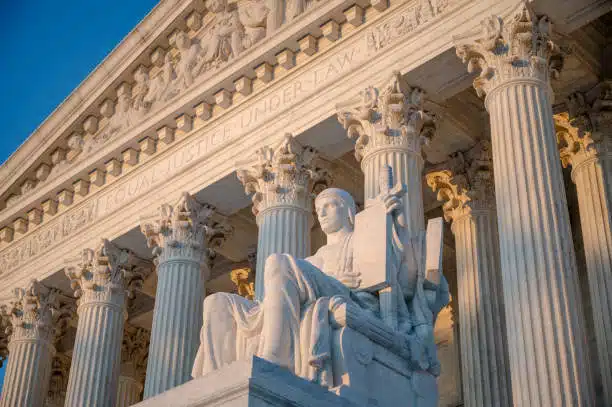
While much of the world and Washington, D.C. were focused on the debate over the major tax and spending bill that President Donald Trump signed into law on July 4, the Supreme Court of the United States (SCOTUS) quietly completed its eight-month term at the end of June. Since October of last year, the nine justices who sit on the highest court in the land have heard arguments in cases related to energy policy, preventative healthcare under the Affordable Care Act, the federal Nuclear Regulatory Commission’s ability to issue licenses to private entities, gun rights, and much, much more.
On the very last day of its term, June 27, in a 6-3 decision, SCOTUS handed down a decision that could have significant implications for the implementation of White House executive orders and for federal agency rules and regulations.
What’s the case, and what could it mean for the future of presidential policies moving forward? Let’s take a look.
What Is Trump V. Casa, Inc.?
As the legal website Oyez explained, President Trump in January issued an executive order (EO) that declared that certain individuals born in the United States would not be granted U.S. citizenship at birth if their mothers were either in the country illegally or temporarily, and if their fathers were not U.S. citizens or lawful permanent residents. The EO ordered federal agencies to comply with the order by refraining from issuing and recognizing documents that affirmed U.S. citizenship for individuals born under these circumstances after February 19, 2025. The EO also mandated that federal agencies revise their policies and issue guidance to implement these new immigration rules.
In practice, as Oyez explained, the president’s EO was a challenge to “long-standing constitutional and statutory understandings of the Fourteenth Amendment’s Citizenship Clause, which has historically been viewed as providing birthright citizenship to nearly all individuals born in the U.S., regardless of their parents’ immigration status.”
Multiple parties, ranging from state governments to individuals whose citizenship status the EO would affect, filed lawsuits. The challenges were heard by three different district courts, all of which issued nationwide injunctions barring federal agencies from complying with President Trump’s EO.
The Trump administration-led U.S. Department of Justice (DOJ) appealed the district courts’ rulings, “arguing that the lawsuits should only apply to the specific plaintiffs and not the entire country.” In other words, the DOJ’s position was that it was fine to rule against the constitutionality of a policy, but that district courts have no authority to apply their ruling to the whole of the United States. Appeals courts, which are one step above district courts and just below SCOTUS, sided with the district court rulings and against the Trump administration.
That’s when the Trump administration asked the Supreme Court to intervene.
The question the Supreme Court justices were to decide was whether a district court may issue a nationwide injunction that blocks enforcement of a federal executive order beyond the specific parties involved in the lawsuit.
As noted above, SCOTUS ruled they may not.
While Trump v. Casa, Inc. concerned a single EO pertaining to birthright citizenship, it will have far-reaching implications for any organization, employer, or individual that could be affected by federal rulemakings. Let’s now examine what the six justices in the majority intended the effect of Trump v. Casa, Inc. to be. After that, we’ll look at what the likely outcome is to be.
SCOTUS Sought to Limit Use of Nationwide Injunctions
In their 6-3 decision in Trump v. Casa, Inc., the majority of the court noted that the number of nationwide injunctions has proliferated in recent years.
Indeed, according to the Congressional Research Service, which is the nonpartisan research arm of Congress, there were 12 nationwide injunctions issued during the presidency of George W. Bush and 19 during Barack Obama’s presidency. Both men served eight years in office. In contrast, there were 86 nationwide injunctions issued during the first Trump administration and 28 during the Biden administration. Those terms, of course, each lasted just four years.
Samuel Bray, a law professor at the University of Notre Dame, told National Public Radio the use of nationwide injunctions is “a recent innovation” that can be attributed to “a meteoric rise over the last 10 years” in the number of executive orders presidents have issued.
The explosion in the use of national injunctions has had its critics. In fact, members of the Supreme Court’s majority in Trump v. Casa, Inc., including Justices Clarence Thomas and Samuel Alito, had disparaged their use even before the case came before their court.
Four other justices agreed with Thomas and Alito.
In Trump v. Casa, Inc., the majority determined that nationwide injunctions exceed the authority that Congress has provided to federal tribunals. More specifically, the majority “said federal district court injunctions generally can only be as broad as they need to be to provide relief to the parties in the suit at hand,” HR Morning explained. “In so ruling, the Court rejected the argument that nationwide injunctions are needed to provide complete relief, and that without them, piecemeal litigation will cause confusion.” (More on that potential outcome in the next section.)
The immediate effect of the ruling in the case, National Public Radio said, is “that using injunctions as a default option to block Trump executive orders is effectively dead.” In general, federal courts can no longer “grant universal injunctions based on fairness, justice, and principles of equity, rather than the letter of the law.”
There are some exceptions to the ruling, however, and lower court judges did not waste much time leveraging those carve-outs.
District Court Judges Are Already Reacting
According to Politico, while losing the ability to issue nationwide injunctions “is clearly a sea change for the judiciary, early results indicate that judges see other paths to impose sweeping restrictions on government actions they deem unlawful.” Importantly, those options remain viable in many major pending lawsuits against the administration.”
Politico cited the post-Trump v. Casa, Inc. decisions of three district court judges as evidence of its hypothesis that lower court officials will find ways to creatively — and perhaps, lawfully — circumvent the Supreme Court’s ruling on nationwide injunctions.
For example, as Politico explained, just days after the SCOTUS decision, U.S. District Judge Randolph Moss rejected the Trump administration’s effort to ban asylum for most people trying to cross the U.S.-Mexico border. While his decision would have nationwide implications, Judge Moss “emphasized that his decision was not one of the now-verboten injunctions.” Instead, he said his ruling “relied on two alternative routes the Supreme Court acknowledged remained available for those challenging Trump’s policies: class actions, which allow large groups to band together and sue over a common problem, and the Administrative Procedure Act (APA), a federal law that permits courts to ‘set aside’ federal agency actions that violate the law, including rules, regulations, and memos laying out new procedures.”
The same day, U.S. District Court Judge John Bates ruled government officials must restore hundreds of federal web pages that contained gender-related data. (The pages had been deleted after President Trump issued his executive order cracking down on “gender ideology.”) As Politico explained, “Despite the nationwide implications of his ruling, Bates emphasized that the APA allows courts to effectively undo unjustified agency action, adding that,” in Trump v. Casa Inc., “even the Justice Department did ‘not argue that more tailored relief is even possible here, let alone appropriate.’”
In a third case in Massachusetts, U.S. District Court Judge William Young also cited the APA as justification for ruling the Trump administration must restore health research grants.
Politico’s conclusion? While SCOTUS’s June 27 decision in Trump v. Casa, Inc. could “dramatically chang[e] the legal landscape for generations” more likely it will result in the opponents of federal rules, regulations, and policies refocusing “their complaints and arguments on class actions and ‘setting aside’ agency actions, rather than ‘universal injunctions.’” More practically, the law firm Fisher Phillips said the ruling against national injunctions will result in:
- More litigation and a proliferation of class action lawsuits;
- Longer litigation timelines;
- Regulatory enforcement that differs by region; and
- Executive agencies that believe they have more freedom to implement sweeping changes through regulations and guidance.
As usual, SCOTUS packed a powerful punch at the very end of its term.